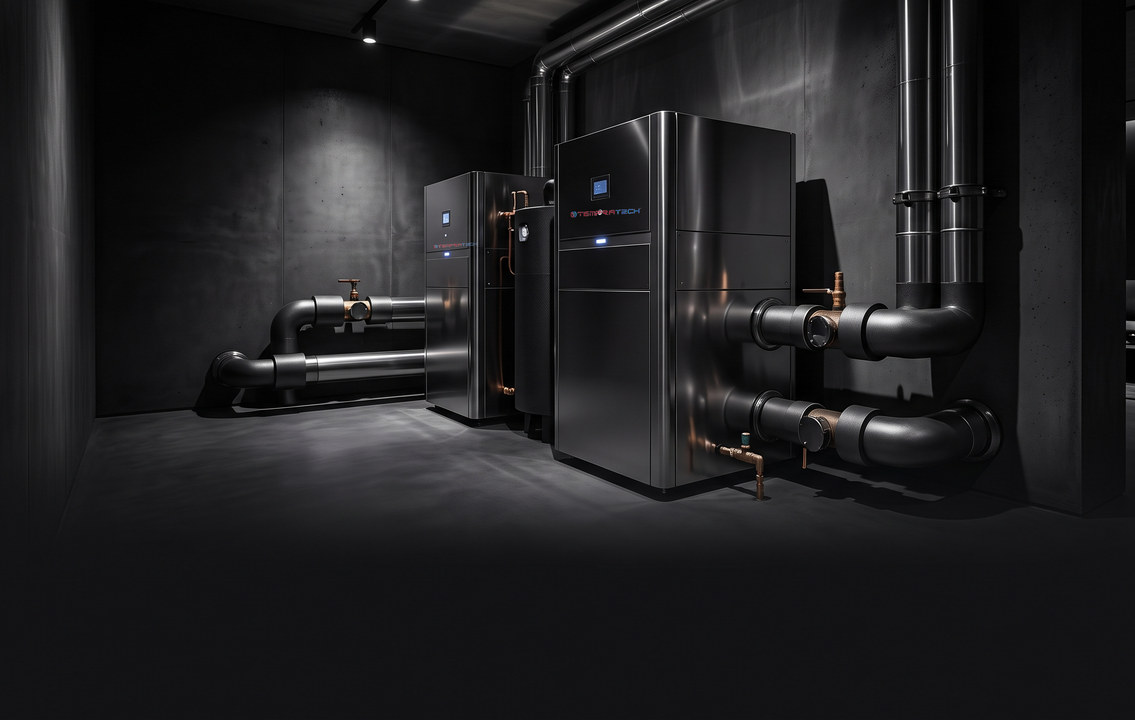
Heat pump technology explained by a Jaipur manufacturer
How a heat pump water heater works, what COP means, how much it can save, and the six heat-pump families Tempratech builds in Jaipur.
A heat pump water heater does not make heat. It moves heat that is already in the air into your water, using a refrigerant circuit and a compressor. Because moving heat takes far less electricity than generating it, a heat pump can deliver the same hot water as an electric geyser for a fraction of the running cost. That is the whole idea, and it is the technology Tempratech has built its range around in Jaipur.
This article explains how the technology works, what the efficiency figures on a datasheet actually mean, and how the different types of heat pump fit homes, hotels, hospitals, pools and industry.
Key takeaways
- A heat pump moves heat from the air into water instead of generating it, so each unit of electricity delivers several units of heat.
- That ratio is called the COP. A COP of 4 means four units of heat for one unit of electricity, or about 75% less electricity than a resistance heater for the same hot water.
- COP depends on the conditions: the air temperature, the water temperature and the load. Compare figures only at the same conditions.
- Different jobs need different heat pumps. A villa, a hotel, a pool, a hill-station hostel and a dye house each need a different machine.
- The heat pump is only part of the system. Storage, water treatment, installation and service decide how well it performs for years.
What is a heat pump?
A heat pump is a machine that moves heat from a cooler place to a warmer one. Your refrigerator does exactly this: it pulls heat out of the food compartment and releases it through the coils at the back. A heat pump water heater runs the same process the other way round. It pulls heat out of the outdoor air, even air that feels cool, and releases it into your water.
An electric geyser works differently. It passes current through a resistance element, and every unit of electricity becomes, at best, one unit of heat. A heat pump uses its electricity to drive a compressor that moves heat, and the heat it moves is several times the electricity it uses.
How a heat pump works, step by step
Every air-source heat pump water heater has four main parts, connected in a sealed loop with a refrigerant flowing through them.
- Evaporator. A fan draws outdoor air across a coil filled with cold, low-pressure refrigerant. The refrigerant is colder than the air, so it absorbs heat from it and evaporates into a gas.
- Compressor. The compressor squeezes that gas. Compressing a gas raises its temperature, so the refrigerant leaves the compressor hot. This is the only stage that uses significant electricity.
- Condenser. The hot refrigerant passes through a heat exchanger in contact with your water. It gives up its heat to the water and condenses back into a liquid.
- Expansion valve. The liquid refrigerant passes through a valve that drops its pressure and temperature, ready to absorb heat from the air again.
The cycle repeats continuously while the water is heating. The heated water is held in an insulated storage tank so it is ready when you open the tap.
What COP means, and why it matters
The efficiency of a heat pump is described by its coefficient of performance, or COP: the heat delivered divided by the electricity used. A resistance heater has a COP of about 1. Tempratech's ranges are rated, for example, at:
- All-in-One domestic units (TT-ALL): COP 3.85–4.07
- Domestic split units (TT-MNB): COP 4.0–4.13
- Commercial units (TT-CM): COP around 4.2
- Swimming pool units (TT-SP): COP up to 6.9
- High-temperature units (TT-HT): COP 3.4 while producing 80 °C water
The arithmetic is simple. At a COP of 4, a heat pump uses about a quarter of the electricity a resistance heater needs for the same hot water, a saving of about 75%. In favourable conditions the saving can be higher, which is why our range pages quote savings of up to 85% against electric geysers.
But a COP is always measured at particular conditions. A heat pump delivers more heat per unit of electricity when the air is warm and the water does not need to be very hot, and less when the air is cold or the water must be hotter. That is why the high-temperature range has a lower COP than the pool range: lifting water to 80 °C is much harder work than warming a pool. When you compare heat pumps, compare them at the same air temperature, water temperature and load. We explain how to do that in what a COP figure does not tell you.
To estimate what a heat pump would save on your own bills, try the savings calculator.
Does a heat pump work in Indian conditions?
It does, provided it is built and selected for them. Indian sites are hard on equipment in ways a European catalogue does not always anticipate: very hot summers, cool winter mornings in the north, unstable voltage and, in many cities, hard water. Tempratech builds for those conditions:
- Winter operation. Our units keep running down to 0 °C ambient without shutting down. In Jaipur, where January nights average around 8 °C, that covers the cold morning peak with margin.
- Cold and high-altitude regions. For Jammu & Kashmir, Himachal Pradesh, Uttarakhand and other cold areas, the cold-climate EVI range uses Enhanced Vapour Injection to keep output up as the temperature falls, delivering hot water down to −30 °C.
- Voltage protection is built in, so supply fluctuations do not damage the unit.
- Brand compressors. Units use Copeland and Panasonic compressors, with Copeland scroll compressors in the commercial range.
- Hard water. Scale is the slow enemy of any water heater, so water quality is part of every system we design, and our storage tanks use Glass Blu Magic Titanium Technology. Read more about how hard water affects a heat pump water heater.
Types of heat pump, and where each one fits
There is no single heat pump that suits every building. Tempratech manufactures six families, each designed for a particular job.
Domestic heat pumps for homes and villas. All-in-One units combine the heat pump and tank in one footprint, with 200, 300 or 420 litre tanks and water at 65 °C in eco mode or 75 °C in hybrid mode. Split units pair a compact outdoor unit of 3.5–9.3 kW with a 200–500 litre tank. Hot & Cold models deliver both, from 8 °C to 60 °C.
Commercial hot-water heat pumps for hotels, hospitals and institutions, from 14 kW to 180 kW. The larger units deliver 1,510–3,870 litres of hot water per hour at a 40 °C temperature rise, and several units can run in parallel for bigger loads.
Space heating and cooling with reversible inverter units from 8 to 90 kW. They produce water from 7 °C to 55 °C, so the same pipework can heat a building in January and cool it in May.
Swimming pool heat pumps from 11 kW to 220 kW, with titanium condensers that resist pool chemistry, for year-round swimming in hotels, clubs and homes.
High-temperature heat pumps for industry, delivering process water at 80, 95 or 120 °C for clean-in-place, sterilisation, dyeing, washing and drying. A two-stage cascade circuit reaches temperatures ordinary heat pumps cannot.
Cold-climate EVI heat pumps for hill stations and high-altitude sites, rated down to −30 °C.
Who uses heat pumps?
Anywhere that uses a lot of hot water, every day, is a strong candidate:
- Hotels and resorts, where guest showers, kitchens and laundries run on hot water around the clock. Our article on choosing a heat pump for a Jaipur hotel sets out the checks to make before buying.
- Hospitals and healthcare, which need dependable hot water at controlled temperatures.
- Group housing, with central plant for towers or individual units for each flat.
- Pools, spas and wellness centres.
- Industry, for process hot water that would otherwise come from a boiler.
- Homes and villas, where a family's daily hot water is a significant share of the electricity bill.
Why choose a heat pump manufacturer in Jaipur
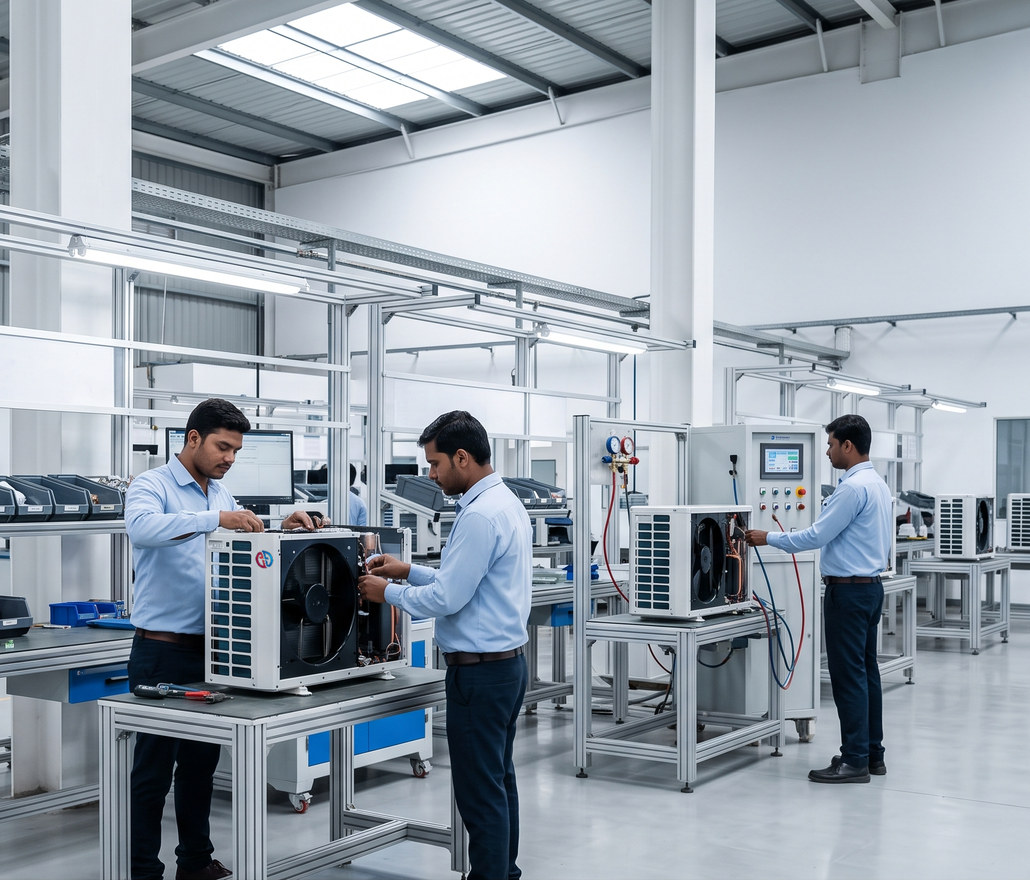
Tempratech was founded in Jaipur in 1996 as a plumbing and public-health engineering practice, serving hotels across north India. Our first commercial heat pump went into a 60-key hotel in 2009, replacing diesel-fired calorifiers. In 2016 we brought manufacturing in-house and earned AHRI certification. Thirty years on, more than 10,000 Tempratech systems are running across more than 20 states, supported by a team of 140 people.
That history shapes how we work. We started on the plumbing side, so we look at the whole hot-water system, not just the box on the roof: the demand, the storage, the pipework, the water quality and the service plan. We make heat pumps and nothing else, and the same team that sizes a system is the team that services it years later. Our client list includes hotel groups such as JW Marriott, Hilton and The Leela, hospitals such as Fortis and NIMS University in Jaipur, and industrial companies such as Bosch and Godrej. You can see more on our projects page.
Being based in Jaipur also means our engineers are close to projects across Rajasthan and north India, from the first site survey to commissioning and after-sales service.
Frequently asked questions
How is a heat pump different from a solar water heater?
A solar water heater depends on sunshine reaching its collectors. A heat pump draws heat from the air, so it works at night and on cloudy days, and it needs only a small outdoor footprint rather than a large area of roof facing the sun.
Will a heat pump work in a Jaipur winter?
Yes. Tempratech units keep running down to 0 °C ambient, and Jaipur's January nights average around 8 °C. Output does fall as the air gets colder, so a system should be sized for the coldest morning it has to serve, not an average day. For colder regions, the EVI range works down to −30 °C.
How much electricity does a heat pump save?
At a COP of 4, a heat pump uses about a quarter of the electricity of an electric geyser for the same hot water, roughly 75% less. Savings of up to 85% are possible in favourable conditions. The actual figure depends on your climate, water temperature, usage and the system's design, so use the savings calculator or ask us for an estimate for your property.
What size heat pump do I need?
It depends on how much hot water you use and when you use it, not just on the number of rooms or occupants. For larger buildings, read our guide to sizing hot water storage for Indian hotels, or send us your details and we will size it for you.
Talk to Tempratech
Whether you are planning a home, a hotel, a hospital, a pool or an industrial process, Tempratech can recommend the right heat pump and design the system around it.
Send us the occupancy pattern, the laundry schedule and the plant-room envelope. We’ll model the peak and come back with a plant and storage selection.
Ask for a load model